
Keynote address · The speech and a glossary
tl;dr: media and the moment
SABA Seychelles 2026 · Avani+ Barbarons, Mahé, Seychelles ·
In this brief The speech & glossary
SABA Seychelles 2026 · Mahé, 22 October 2026
Click to start, then use the arrows, swipe, or click a slide to explore.
Open separately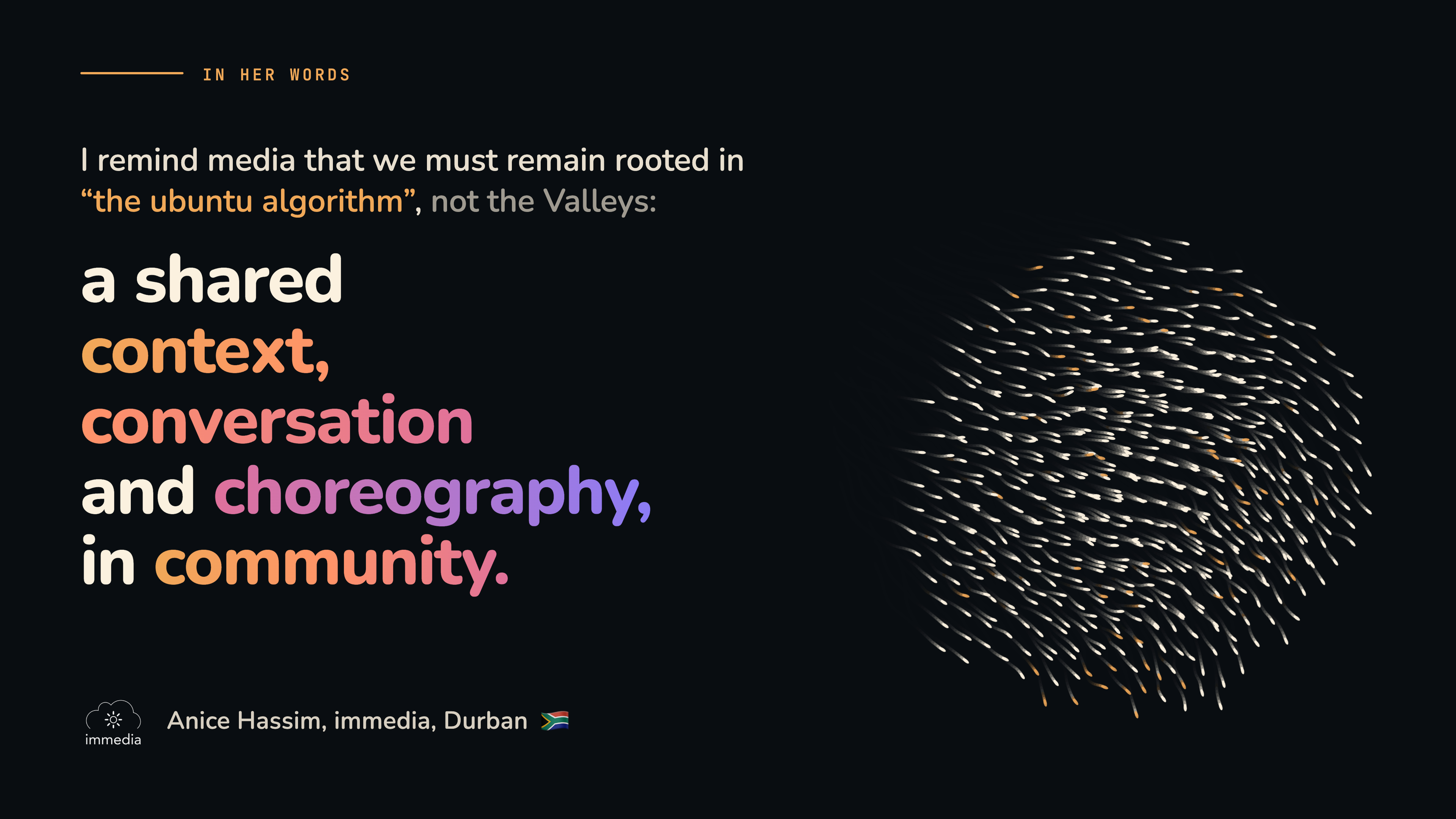
The pattern
Before I begin, let’s start at the very beginning. I want to explain a pattern in the universe: a relentless, fractal loop of efficiency. We need to understand it, to anticipate what comes next. There’s no magic in it; it’s just math. But it was only in my youth that we had the math to calculate it.
An essential, simple pattern. It eliminates lag. It includes more within it, through replication. It compresses time, elevating everything to the realtime. A fractal pattern, at every scale: from the stars, to the cell, to the way we live.
That’s the physics of the universe. But there is another, the metaphysics, born of an intelligence that looked up at the skies and wondered. Incredibly gifted, they noted their knowledge of patterns and passed it on to each new generation. They could see that the pole stars never moved. They could trust that beacon, and plant their crops and navigate their lives by it.
tl;dr
Tl;dr. This is the age we live in. Now some older people might be wondering: what is tl;dr? In South Africa we have tenderpreneurs, even tinderpreneurs. I guess you can call me a tl;drpreneur!
This moment of tl;dr: that’s internet slang for “too long, didn’t read”. That’s the moment media finds itself in. We compete with memetic engineers who can use a Lego meme to bring down an empire.
Into this already disruptive change comes AI. And the next interface is here: it’s conversational, it’s ambient and it’s intelligent. What does that mean for media? Let’s find out.
My name is Anice Hassim, from immedia. Honoured guests, delegates, convenors and the SBC team: thank you for the privilege of addressing you. I bring greetings from our director, Bra Phil Molefe, who, together with me, met SBC and began a journey of discovery at SABA almost eight years ago.
Now I stand here as a media elder. I remember a time before the algorithm, and I have memories longer than the road that lies ahead. I want to speak from the heart, for in this next era media is our salvation, but only if we remember our past, remember our why, remember we are of Service to the People.
I remind media that we must remain rooted in “the ubuntu algorithm”, not the Valleys: a shared context, conversation and choreography, in community.
So, AI: demon or delightful? Let’s come clean. How many here are using AI? How many are using more than one? How many have named them? Mine are Larry, Daryl, and his other brother Daryl.
Are you ever going back? No, we are not going back. But how will we go forward? This is the question I need you to consider this morning. What do we do with AI? What do we do with the trust our audiences place in us?
Comrade Josephine
I want to tell you a story of my own journey.
It was the State of Emergency. I arrived at the only university I was allowed to attend, not being white. A computer science professor had a Macintosh in his office, and he let me play on it all that autumn and winter. That was my wonder curve: a young intelligence looking into this machine and wondering, what can I do with this?
It wasn’t computer science that began my life in technology. It was dropping out of it, into media, in a youth movement at the centre of history; and then falling into it again, a decade later.
For I discovered that this pinnacle of Western technology completely changed the odds. We could rapidly produce print materials through desktop publishing. I convinced my student council to break the sanctions and import a Macintosh.
Posters for mass meetings. Operating our campus radio station. When the state killed one of us, the truth was on a pamphlet by morning, made far from the printing press where the Special Branch waited.
We were with her night and day. She was a teammate, not a machine. We called her Josephine.
Her hardest job was the memorial pamphlets for our fallen comrades. She helped us keep them in our hearts. I discovered the incredible impact technology can have on a people. You can read the full story of Josephine at medium.com/@anicehassim/josephine-31b099f0c1a7.
The uncanny valley
There are two poles to reality. On one side, the wired world of the cosmos. It measures, it cools, it has distance and lag: a crystal, every part held in place; signal, carried across a wire platform at hyperscale. On the other, the relational world of humans: a web of relationships and, inside it, latent communities. Here, facts are feels and feels are facts. The one melts into the other; there is no hard line between them. Both run on trust.
Now let’s explore where those worlds meet: in the uncanny valley, where a war for our humanity is playing out. In 1970, Masahiro Mori described the uncanny valley: as a thing becomes more humanlike we warm to it, until it is almost human, and then we recoil. Turn that around, and measure how human the system treats us against how human we feel. Most of us live in that valley. It is the cognitive dissonance we all feel. We see it in the world around us.
The ladder of latency
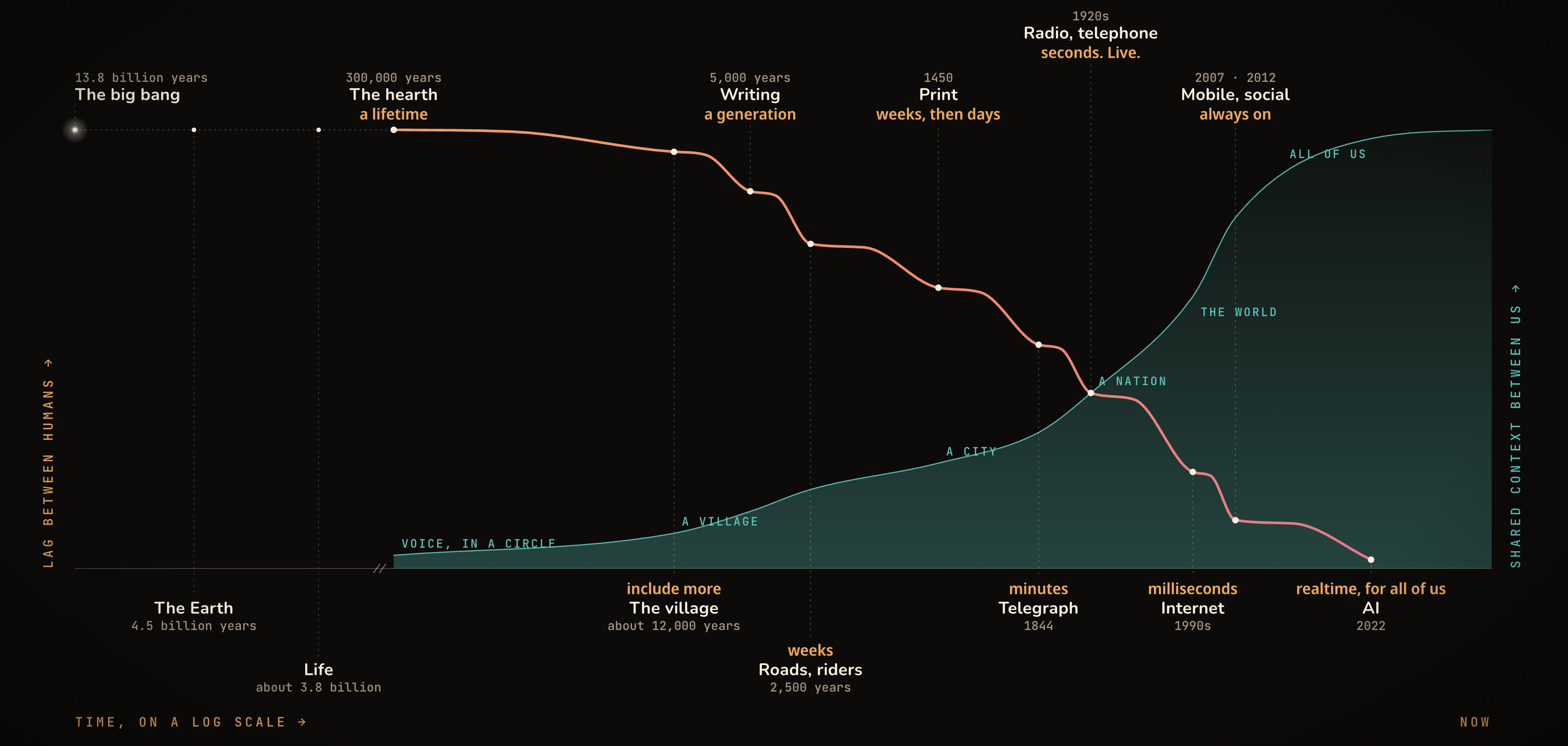
The ladder of latency: as the lag between humans falls, the shared context between us rises. AI is the last rung.
For most of our time on earth, this was the whole network: the first station, voice, in a circle. Humans crave connection. We are not a solitary species. Knowledge moved at the speed of a story, and a story moved at the speed of a lifetime.
Remember that pattern: the crushing of latency, or lag, and the elevation to the realtime. Let’s see how media evolved along it. Thirteen point eight billion years, on one line: the cosmos; Earth, in its Goldilocks orbit, giving genesis to life.
At the hearth, voice in a circle, the lag between humans was a lifetime. As the lag fell, the shared context between us widened. History moves in long flat runs of iteration, then sudden drops, each one a shock: the lag between humans collapsing, the friction removed. Radio and the telephone brought it down to seconds. Live. This is where we came in, as broadcasters: exactly where the falling lag meets the rising context.
Then the internet, the phone in our pocket, the social network. Milliseconds. Always on. A shared choreography. The context window opens to the whole world, and to the person inside it: increasingly personal, contextual and global, all at once.
And now AI: the ultimate low-latency, realtime, inclusive interface, one all of humanity will use, because it needs no special skill other than being human.
This is humanity now: a murmurating, relational network, digital, across a context window as wide or as narrow as our whim. Over the last generation, the blink of an eye in cosmic time, we entered a shared context, a shared conversation, and now a shared choreography; and in the realtime, driven by hyperscale algorithms that are shaping our behaviour.
Lives into data
Now let’s talk about where that pattern is leading us. All those lives, in their lived context. In community. And increasingly fragmented, because the algorithm has been relentless.
Aggregated onto the platform. Labelled. Sifted. Sorted, and ranked. Abstracted into data. Our reality splintered into information bubbles and separate feeds. The human story slips from view. We are reduced to points in an array: a boy on his small planet, and his dog, pixel by pixel.
Our memories, carried on the cosmic wind. And with them, our humanity.
How many of us are human?
Systems are falling through our lives like rain: deciding what to amplify, what to recommend, what to keep asking us to watch. Some of it is useful. Some of it is delightful. But whose purpose is running through the network? Who does it serve?
How many of us are human?
Let me tell you how one algorithm counts us. Whose algorithm it is, I will tell you in a moment. I will use my country, South Africa: a middle country, rich in some things, desperately poor in others. Forty-five million adults.
There are only 1,347 humans in South Africa. Counted by whom? And who gets served in their own context, and recognised as themselves?
Picture the adults of South Africa on one small blue dot: the forty-five million an algorithm can see. How many of us does the machine consider human? Humans: 1,347. Human adjacent: 46,853. Almost humans: about 680,000. Not humans: nearly forty-four million adults. And inside them, 7.3 million it does not see at all. Drawn to scale, the first three are hairlines. Most of us are not human. Not even near human.
So whose count is this? It is the banking algorithm; we run their adverts, after all. These are its names for us: ultra-high net worth, high net worth, mass affluent, mass retail, unbanked. Only 1,347 get a human who knows the context of their lives. Everyone else is served by the machine: an app, a call centre, a score. Data does not discriminate. Metadata does. The richer you are, the more human the machine sees you. All well and good in aggregate; an absolute disaster for Mrs Singh, Sowazi or Smith in specific.
The media algorithm has always been a human one, never the technology of the day.
Trust changes phase
Trust has geometry. For millennia it flowed down: from the tower, through institutions, to the many. Vertical, slow, one way. Trusted because it had lasted. We learnt to reach people from the tower out.
The polar ice of trust, locked in institutions, melted as shared context rose. Trust changed phase. It became more fluid. It did not disappear; it moved sideways, through proximity: neighbourhoods, professional circles, cultural communities, faith networks. People who recognise one another and remember how they have behaved. In today’s moments of crisis, community is the first responder.
When trust is more abundant, latency drops: a small change in trust, a large change in tempo. We built our towers on the high ground, or in strategic places like the Indian Ocean relays. But community is the high ground now, and trust is the carrier signal.
We remember
I remember what life was like before the algorithm, and so do many of us in this room. We have memory. With memory we can discover meaning; without memory, we don’t know who or what we are. Who is preserving our memory? Who is telling our stories? Who safeguards our future?
Do you remember your father’s eyes? Your grandfather’s smile? Your great-great-great-great-grandmother’s face? Your nose does. It is embedded in the pattern of your genes: the organic, the living, the human pattern, not the machine pattern. In your DNA, the algorithm of living things. And this pattern remembers.
So. The algorithm is not going to stop. If we listen to the technology vendors, the algorithm I have just described, the pyramid of inequality, is what we will be complicit in. There is a growing movement that says we must not use AI: that we must avoid it, shun it.
I have lived off the algorithm. I never joined Facebook, and my number is not on WhatsApp. I refuse to be complicit. But that genie is out of the bottle, and I, for one, will not unilaterally disarm. It is being used against me, and I will fight the hegemons and hyperscalers with it, just as we used technology a generation before.
When all the world’s an algorithm, what is the point of being human? To be more human. The more our world is ruled by algorithms, the more we will demand to be treated as humans.
Forward deployed humans
So how will we enter this new frontier? The tech world likes to talk about frontier ecosystems and forward deployed engineers. But where are the people? Where are the forward deployed humans in this AI age? The truth is, they are absent.
Except in one place. Media already has them. Media is the one mechanism in society that already has the human skills to curate AI. You do not need to know how a model works to know that a story has been told wrongly.
We need to be what we call ourselves in our name: public service media. Broadcasting describes how we reach people. Public service describes why we are there.
Team Human
Our perspective comes from human technology, at the intersection of art, science and community. We have always been on Team Human, not Team Machine. And in the uncanny valley we find ourselves in, we fight a war for our humanity, against the relentless machine. Against abstraction.
We don’t want to become digital platforms, complicit in the desiccation of humanity. We want to become better radio: community. Better storytellers: film and television. And trusted intermediaries of the truth of the world out there: news, current affairs, documentary.
When it comes to AI, we want to steward it to carry what is oldest in us. We are storytellers. We are trusted heralds. We are entertainers. We are the echo, Leko, of our people. We are not wires and systems and algorithms and machines designed by a few. We are a messy society, designed by all. Team Human. Team us. Team freedom.
From content to context
We have never served a demographic. We are many things, all at the same time. We live in communities within communities, circles within circles: where we live, who we know, what we love, what we do together. The communities I can belong to are a thousandfold my parents’. The new unit of audience is the community, in every dimension.
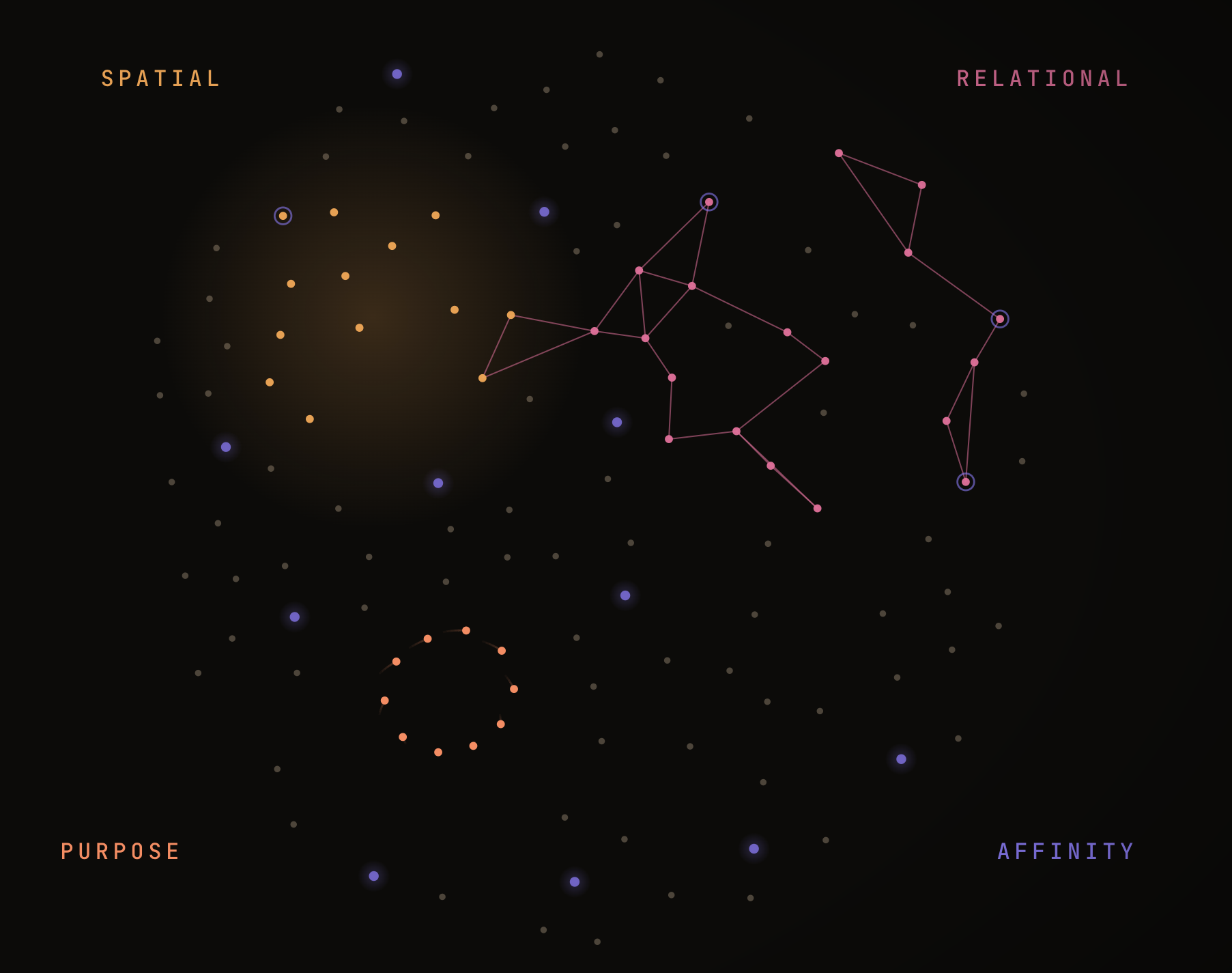
Not a demographic, a community, in every dimension: where we live, who we know, what we love, what we do together.
Once, we had a monopoly on information and entertainment. No longer. We compete with memetic engineers who compress an hour’s storytelling, the old way, into a minute’s clip, often watched with the sound off and the subtitles on. It’s not just short attention spans; that’s too simplistic. I believe it is the desire to be part of the story, not to be told the story. Just bring me up to speed, so I can tell you my opinion. It’s impatience to participate.
And all of us can tell stories now, and do, through social infrastructure that is not actually media, although they have branded it thus. It is anti-social media. We, the real media, can domesticate that terrain: by being present in the realtime, by bringing humans into their loop.
People have always had a voice. What we can offer is context. Context is the life around the content, known with consent. The audience tuned into our content. Now we must tune into the audience’s context.
The new interface
AI can shift context for us, incredibly effectively. We need to be context-fluid, and AI allows us, as media, to achieve that. Let me show you what we are exploring here in the Seychelles. Meet the prototype media AI for SBC: Leko. Leko offers a low-latency, low-friction, persistent connection that can remain ambient in citizens’ lives, leaning in or leaning back.
On SBC Radio’s node, Leko answers an emergency with the number first, and nothing in the way. It takes a dedication during a party, and another by voice from the car on the drive home. It tells a dive centre what a campaign would cost. It plays a festival morning mix, and plans a free day in Victoria and on La Digue.
Press its dial, and it dials language: English, French, Kreol. The same questions, answered in the language of the person asking. The fact that it is bad at Kreol tells us why our mission is important. It’s understandable, but not how Seychellois would speak. Only we can correct it.
Why game attention for an hour, when you can be of service for thirty seconds and be helpful? The next interface a media owner must build to is a resident intelligence. Not an app. Not a website, a portal or a super app.
Through AI, we can keep the reach, and deepen the relationship. All of the legacy surfaces remain; not all change comes at the same time. But the fastest surface, the lowest latency, is chat. The relationship stops resetting.
The economics
Now the question every CEO in this room is asking: what will the economics be? Look inside the relationship. It is not one crowd but a network of communities, each one known: a media owner’s relational network. And it yields on four layers. Trusted digital infrastructure: the rails everyone else has to rent. Governance and compliance: what a bank, a council or a clinic will pay for. Services: transactions in context, where the margin is. And data and AI: first-party, consented, human data, the only data worth having.
If you want the proof from a broadcaster, look at MS NOW, the former MSNBC. Its carriage fees are shrinking, so it has gone all in on community. Not another streaming product: a membership, launched in September, with its journalists in the room and members talking to each other. Its president calls it the first step in a long-term strategy to deepen the relationship with the audience. Its live events sell out, and it plans to triple them. That is the most valuable audience a media owner can have, because it is the only one that is yours.
The loop is human
Everyone is building workflows now, with a human in the loop. But humans are not in the loop. Humans are the loop. Born. Named. Taught. In love. Raising a family. Caring for our parents, then cared for ourselves. Remembered. Radio has always lived inside that loop: the birthday request, the wedding dedication, the funeral notice. We don’t want humans in the technology loop. We want technology in the human loop. Because they trust us, we become part of the loop of their lives: everywhere, all at once, in the full prismatic spectrum of humanity.
Early to our own
There was a time when Africa was behind the technology curve. Now that the pendulum has swung, we are not late to someone else’s future anymore. We are early to our own. Just as mobile went over the top of the landlines, in an age of generative AI that enables all humans, we can go over the top of the hyperscale platforms. The hyperscalers are the landlines of the modern age.
The technology can come from anywhere. The judgement about how it belongs in our lives must be rooted here. Here, the honourable Vice President of the Seychelles stresses regional cooperation, to provide opportunities to exchange ideas and experience, and to develop skills. We need to build ecosystems, not supply chains. We need partners, not vendors unrooted in common context.
The edge is rising
The edge is rising. When the edge becomes the centre, a wider world comes into focus. The edge is no longer where the network ends; it is where the person lives. It is not about what we don’t have, the railway we didn’t build or the roads we can’t afford. It is about what we can do together, with common purpose and trust. In this era of generative intelligence, instead of building generational wealth for a few, let’s build generative wealth, for all: a common wealth, built on common ground, spiritually, materially and practically.
Trust is hard infrastructure, and media has it. In a crisis, we are still the trusted heralds. We have to be that pole star of trust I spoke of at the start.
That dot
Look again at that dot, the pale blue dot where we began. That’s here. That’s home. That’s us. Everyone who ever lived, everyone we have ever loved. We are all starstuff, born out of the cosmos.
Thank you.
Glossary
The terms a reader meets in the speech, in plain words, in the order they first appear.
From the talk
| Term | What it means here |
|---|---|
| The pole star | The star that holds still while the sky turns, by which people planted their crops and found their way; the talk’s figure for the trust media must keep. |
| tl;dr | Internet shorthand for “too long, didn’t read”: the short attention, and the wish to be part of the story rather than told it, that media now speaks to. |
| Tenderpreneur | South African slang for someone who gets rich on government tenders, usually through connections rather than merit. The speech plays on the word. |
| Ubuntu, the ubuntu algorithm | Ubuntu is the Nguni word for the humanity we share, from the saying umuntu ngumuntu ngabantu: a person is a person through other people. “The ubuntu algorithm” is the speech’s phrase for media rooted in it: a shared context, conversation and choreography, in community. |
| The wonder curve | The moment an intelligence looks up, or into a new machine, and wonders what it all means: the first spark of curiosity. |
| The uncanny valley | Masahiro Mori’s 1970 observation that we warm to a thing as it becomes more humanlike until it is almost human, and then recoil. The talk turns the axes on us: how human the system treats us, against how human we feel. |
| Latency, lag | The delay between people: between a thing happening and others knowing of it. The talk reads the history of media as that lag collapsing, from voice in a circle to the realtime. |
| Context window | The shared context between people, widening with every step from the hearth to AI; also the AI term the talk borrows for it. |
| Murmuration | The swirling flight of a flock of starlings, moving as one with no leader; the talk’s image for how people now move together, in a shared context, conversation and choreography. |
| Counted by whom? | The question the talk asks of any count of people, and the line that always travels with the 1,347. |
| The bank’s names for us | Ultra-high net worth, high net worth, mass affluent, mass retail, unbanked: the tiers a bank sorts its customers into by wealth, which the talk sets against its own labels for how human the machine sees each of us. |
| Trust changes phase | Trust moving from a vertical flow (the tower, institutions, the many) to a lattice of proximity: neighbourhoods, professional circles, cultural communities, faith networks. |
| The carrier signal | Trust, in the talk’s figure: what the message rides on. |
| Forward deployed humans | After the tech world’s “forward deployed engineers”: the editors, curators and fact-checkers media already has, the human skills to curate AI. |
| Team Human | Media’s side in the war for our humanity: better radio, better storytellers, trusted intermediaries of the truth, stewarding AI to carry what is oldest in us. |
| Desiccation | The drying out of humanity as lives are aggregated, labelled, sifted, sorted and abstracted into data. |
| Leko | Kreol for the echo, as the speech says (“the echo, Leko, of our people”); also the name the Seychelles Broadcasting Corporation gave the prototype media AI shown on stage, on SBC Radio’s node. |
| From content to context | The turn the talk asks for: the audience tuned into our content; now media must tune into the audience’s context, the life around the content, known with consent. |
| Resident intelligence | An AI that lives among a community under its mandate, answering to the people it serves; the next interface a media owner must build to. |
| The four layers of yield | Trusted digital infrastructure; governance and compliance; services; data and AI: what a media owner’s relational network earns on. |
| Humans are the loop | The reversal of “a human in the loop”: our lives are the loop, and technology joins it under our mandate. |
| The edge is rising | When the edge becomes the centre: the edge is no longer where the network ends but where the person lives. |
| Generative wealth | The talk’s answer to generational wealth for a few: a common wealth, built on common ground. |
| Look again at that dot | After Carl Sagan’s Pale Blue Dot (1994), written on the photograph of Earth that Voyager 1 took from beyond Neptune: “That’s here. That’s home. That’s us.” Sagan also wrote that we are made of star-stuff. |
History, people and places
| Term | What it means |
|---|---|
| SABA | The Southern Africa Broadcasting Association, which brings the region’s broadcasters together; SABA Seychelles 2026 is its gathering in Mahé. |
| immedia | A technology company in Durban, South Africa, working at the intersection of art, science and community. |
| SBC | The Seychelles Broadcasting Corporation, the host broadcaster. |
| Bra | South African township usage for “brother”, an affectionate honorific, as in Bra Phil Molefe. |
| The State of Emergency | The states of emergency of apartheid South Africa from 1985 to 1990, under which the security forces held sweeping powers of detention and censorship. |
| DTP | Desktop publishing: designing and producing print on a personal computer, which the Macintosh made possible from 1985. |
| Sanctions | The international economic and cultural boycott of apartheid South Africa, which restricted trade with it, computers included. |
| The Special Branch | The security police of the apartheid state that watched, detained and interrogated political activists. |
| Kreol | Seselwa Kreol, the Creole language of the Seychelles, one of its three official languages with English and French. |
Media terms
| Term | What it means |
|---|---|
| Memetic engineers | People who craft memes to spread an idea or move a crowd; in the talk, media’s new competition. |
| Hyperscalers | The largest cloud and platform companies; in the talk, the landlines of the modern age. |
| Public service media | Broadcasting that exists to inform, educate and serve the public, usually publicly funded or mandated. |
| MS NOW | The news channel formerly MSNBC, renamed in November 2025 and spun out of Comcast with Versant Media Group; the talk’s proof from a broadcaster of a relationship that earns on every layer. |
| Carriage fees | What distributors pay a channel to carry it; the base of a television channel’s revenue. |